
AI Lawyer: Your 24/7 Legal Assistant for Questions, Documents, and Research
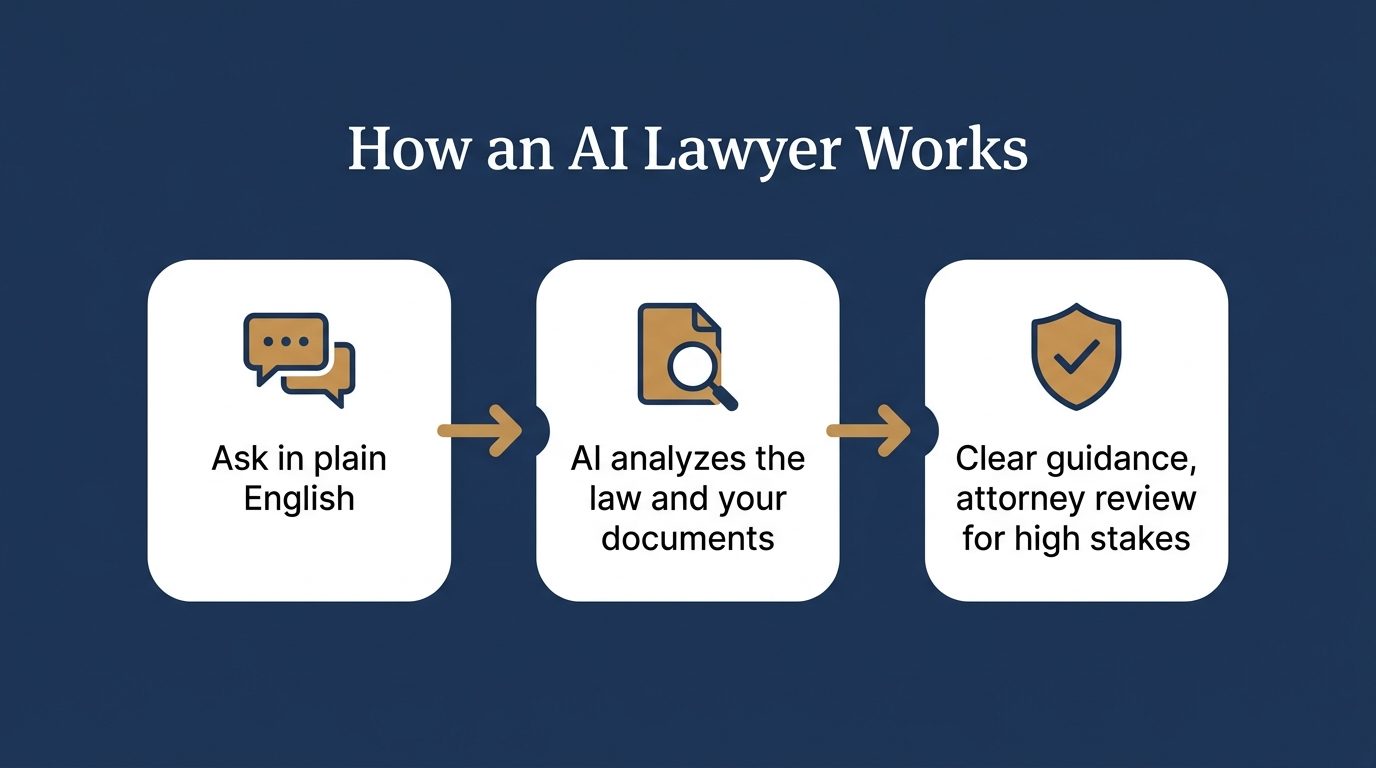
Legal help used to mean scheduling an appointment and waiting days for a callback. An AI lawyer changes that: it’s an AI-powered assistant that answers legal questions in plain English, drafts documents, and researches relevant law in minutes, any time of day.
The average U.S. attorney bills around $349 an hour, according to Clio’s 2025 Legal Trends Report — an AI assistant handles routine questions for a fraction of that cost, sometimes for free. That said, an AI lawyer provides general legal information, not a substitute for advice from a licensed attorney, and this article is not legal advice.
What Is an AI Lawyer and How Does It Work?
An AI lawyer is a type of AI legal assistant — software built on a large language model (LLM), typically in the GPT-4 or GPT-5 class, trained and prompted to reason about legal questions. Instead of searching statutes yourself or booking a consultation, you type a question in everyday language and get an answer grounded in relevant law. Most established platforms in this space run on web, iOS, and Android, so the assistant is available from a phone or laptop whenever a question comes up.
How an AI legal assistant answers questions
The typical flow is conversational: you describe a situation and the assistant explains which rules apply and what your options are. Some services generate a short report at the end of the chat, summarizing the issue and suggested next steps. Common topics covered by consumer-facing legal AI tools include:
- Family law and divorce questions
- Employment and workplace disputes
- Consumer rights and rental disputes
- Debt collection and traffic fines
- Small business formation
- Wills and estates
The technology behind legal AI
These tools are built on generative AI — large language models trained on enormous text corpora, including legal texts. GPT-4 scored 297 out of 400 on the Uniform Bar Exam, and the same benchmarking study found it scoring around 75.7% on Multistate Bar Exam-style questions, compared to roughly 68% for average human test-takers, with particularly strong performance in contracts (88.1%) and evidence (85.2%) (Katz et al., “GPT-4 Passes the Bar Exam,” Philosophical Transactions of the Royal Society A). A later re-evaluation found GPT-4’s percentile ranking drops significantly when compared against all bar takers rather than a narrower repeater-only cohort, so the exact percentile is contested even though the raw score isn’t. Bar exam scores measure legal knowledge recall, not the judgment or licensure required to practice law.
What Can an AI Lawyer Do?
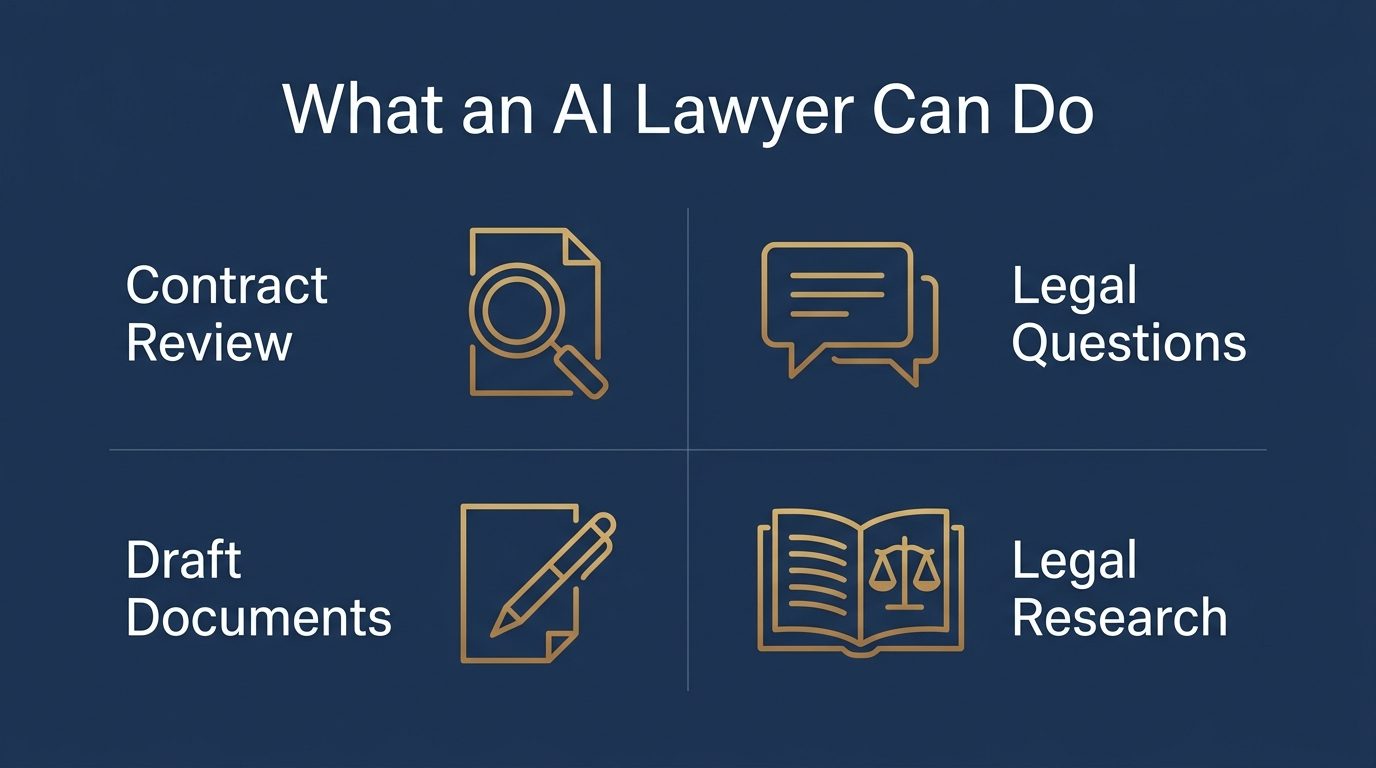
An AI lawyer’s core jobs fall into three buckets: answering questions, drafting documents, and researching law. Some consumer platforms summarize an uploaded document in seconds, while document generation that might take a human lawyer several business days to turn around can often be produced by an AI tool in minutes. Typical document types include:
- Lease agreements and bills of sale
- NDAs and contractor agreements
- LLC operating agreements
- Employment contracts and powers of attorney
| Task | What the AI does | Typical time |
|---|---|---|
| Answer a legal question | Explains applicable rules in plain language | Seconds to minutes |
| Draft a document (NDA, lease, POA) | Generates a customized draft from a template | Minutes, vs. days with a lawyer |
| Summarize a contract or filing | Extracts key terms and flags risk clauses | Seconds |
| Legal research | Finds relevant statutes, cases, and precedent | Minutes |
Answering legal questions 24/7
There’s no appointment and no waiting room — you can ask a question at 2 a.m. and get an answer immediately, often referencing state-specific rules since U.S. law varies significantly by jurisdiction. This around-the-clock availability is one of the main reasons people search for a free AI lawyer chat in the first place, especially for time-sensitive questions like eviction notices or contract deadlines.
Drafting and reviewing legal documents
Traditional legal fees for common documents add up fast: a lawyer-drafted NDA typically runs $350–$1,500, a lease agreement $400–$2,000, an LLC operating agreement $600–$3,000, and an employment contract $500–$2,500 (ContractsCounsel attorney fee data). AI drafting compresses that into minutes. Contract review shows a similar gap — in a widely cited LawGeex study, AI reviewed an NDA in 26 seconds while lawyers averaged 92 minutes, with the slowest taking over two and a half hours, all while flagging non-standard clauses along the way (LawGeex 2018 study).
Legal research and summarization
Beyond answering direct questions, legal AI tools can summarize a lengthy contract or complaint in seconds and surface relevant statutes or case law for a given fact pattern. Professional-grade platforms go further, analyzing legal briefs and running judicial analytics that would take a paralegal hours to compile manually.
How Much Does an AI Lawyer Cost?
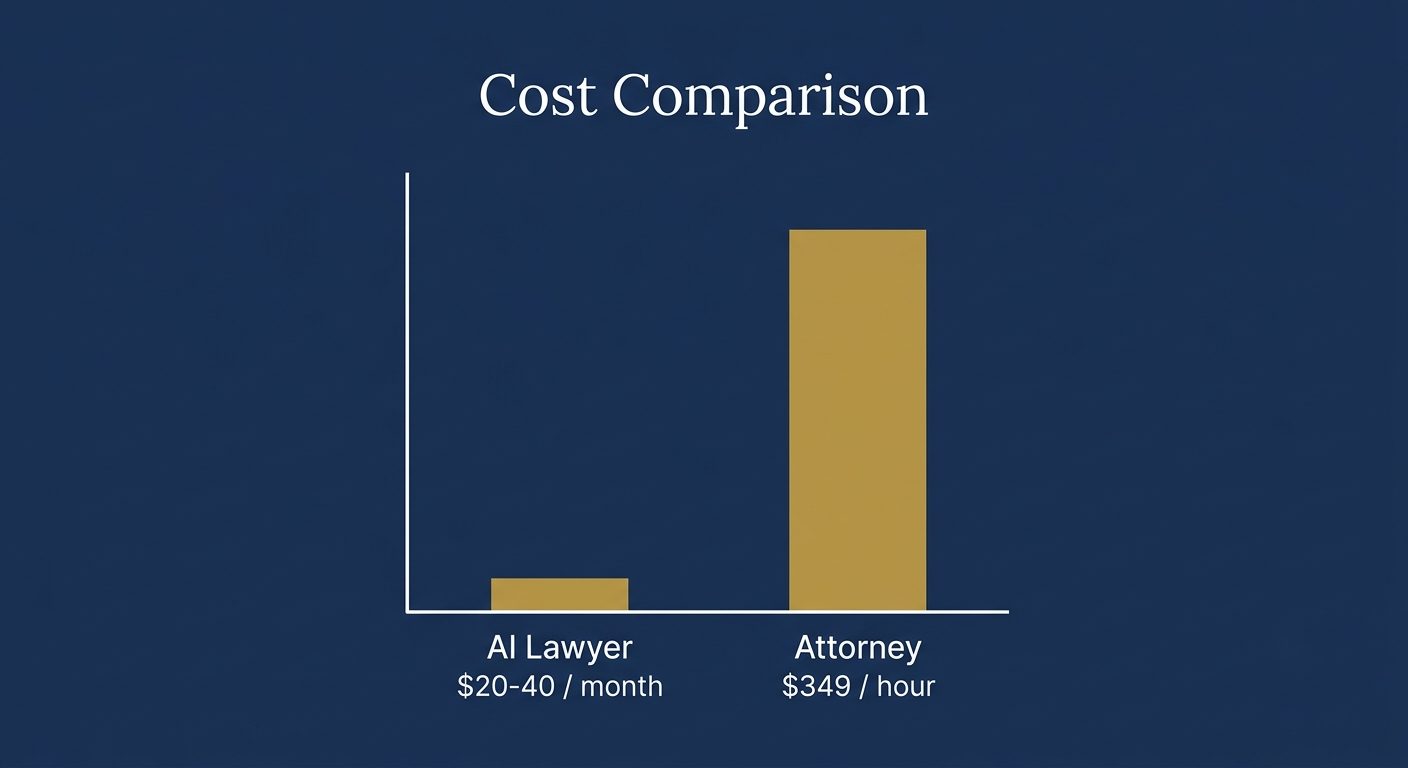
Cost is where AI lawyers make their strongest case against traditional legal fees. With a national average attorney rate near $349 an hour, even a modest AI subscription pays for itself after avoiding a single billable phone call. Some platforms report savings of up to 90% on cost and 75% on time compared to hiring a lawyer for comparable routine work.
| Option | Typical cost | Best for |
|---|---|---|
| Free AI legal chat | $0 | Quick general questions |
| Free AI document generator | $0 | Basic templated documents |
| Consumer AI legal assistant (paid tier) | ~$10–$40/month | Ongoing personal legal questions, unlimited docs |
| Professional legal AI software (law firms) | $150–$2,000/month | Contract review, research, practice management |
| Hiring a licensed attorney | ~$349/hour | Court representation, complex negotiation, high-stakes decisions |
Free AI lawyer options
Genuinely free options exist: some AI legal chat services are free to use, basic document generators are free, and many paid assistants offer a free trial. The tradeoff is specialization — a general-purpose chatbot without legal-specific training won’t reliably give jurisdiction-specific guidance, so free tools work best for low-stakes, general questions rather than anything that could end up in court.
Paid plans vs hiring an attorney
A paid AI legal assistant subscription typically runs tens of dollars a month — far below a single hour of attorney time, and it often pays for itself the first time it replaces a document a lawyer would otherwise draft. Law firms pay more for professional-grade tools, but still less than headcount. Enterprise legal AI software runs $150 to $2,000 a month depending on scale, and alternative legal service models built around AI-assisted lawyer networks report cost savings of 30–50% compared to traditional law firm staffing.

AI Lawyer vs Human Lawyer: Can AI Replace Attorneys?
AI lawyer tools are not a substitute for a licensed attorney, and they cannot represent you in court — the unauthorized practice of law is restricted in every U.S. jurisdiction, and courtroom representation requires a bar license. What’s changed is how many practicing lawyers now use AI as part of their own workflow: adoption among legal professionals reportedly grew from about 19% in 2023 to roughly 79% in 2024, according to Clio’s Legal Trends Report — other surveys with broader, less tech-forward respondent pools show a slower but still fast-rising adoption curve. The often-repeated framing in the profession is blunt: AI won’t replace lawyers, but lawyers who use AI will replace lawyers who don’t.
To maintain the requisite knowledge and skill, a lawyer should keep abreast of changes in the law and its practice, including the benefits and risks associated with relevant technology.ABA Model Rules of Professional Conduct, Rule 1.1, Comment 8
What AI does better
Speed and scale are where AI clearly wins. Among lawyers already using AI in their practice, surveys report roughly 77% using it for document review, 74% for research, 74% for summarization, and 58–59% for drafting memos and contracts (Thomson Reuters Institute, 2025 Generative AI in Professional Services Report). These are high-volume, pattern-based tasks — exactly where an LLM’s ability to process large amounts of text quickly outperforms manual review.
Where you still need a licensed attorney
Court appearances, negotiation strategy, and the ethical duty of care a lawyer owes a client are not things software can take on. Complex disputes, criminal matters, and high-value transactions still call for a human with a license and malpractice liability behind their advice. This is the core YMYL point of this entire topic: an AI legal assistant is a source of general legal information, not a licensed provider of legal advice, and giving legal advice as a practice is restricted to attorneys admitted to the relevant bar.
How Accurate Is an AI Lawyer? Risks and Data Security
Accuracy is the single biggest caveat with any AI lawyer. Bar-exam-style benchmarks put leading models around 75% accuracy, but “mostly right” is a dangerous standard in law, where a single fabricated citation can sink a filing. The clearest cautionary tale is Mata v. Avianca, a 2023 federal case in which attorneys submitted a brief containing case citations invented by ChatGPT — the citations didn’t exist, and the court imposed sanctions on the lawyers who filed them.
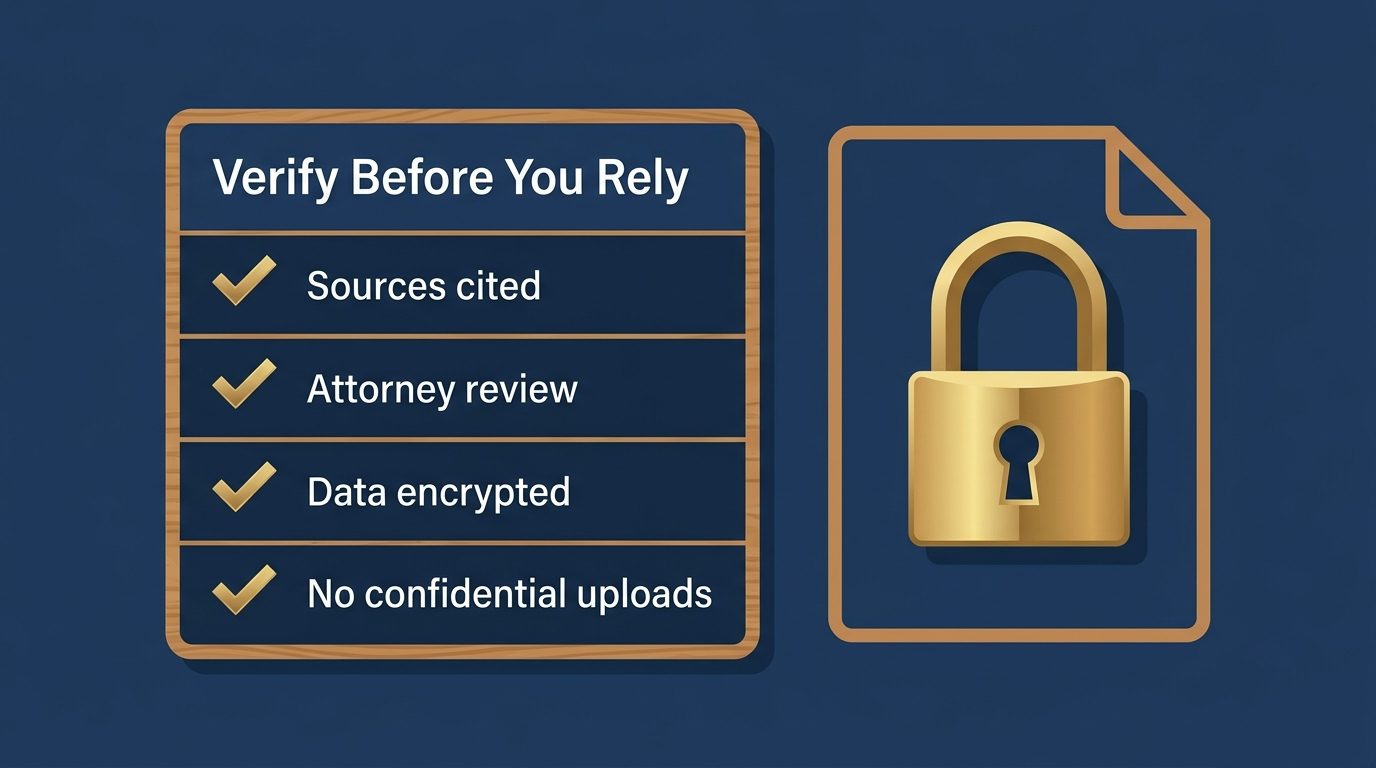
- Ask the AI for its sources. A trustworthy answer should point to a specific statute, regulation, or case.
- Cross-check citations against an official database (your state’s official statutes site, or a court records system) before relying on them.
- Treat the answer as a starting point, not a final word, especially for anything with a filing deadline.
- Avoid pasting confidential information into general-purpose chatbots that aren’t built for legal confidentiality.
- For anything with real money or legal exposure at stake, get it reviewed by a licensed attorney before you act on it.
Hallucinations and how to verify AI answers
The Mata v. Avianca sanctions became a widely cited warning across the legal profession precisely because the fabricated citations looked completely normal — correct formatting, plausible case names, nothing that flagged them as fake without an independent check. The U.S. National Institute of Standards and Technology’s AI Risk Management Framework recommends exactly this kind of ongoing verification and human oversight for consequential AI-generated outputs. Legal-specific AI tools trained on verified case law and built with citation-checking tend to be more reliable for legal work than general-purpose chatbots not designed for the task.
Privacy and confidentiality
Reputable AI legal platforms encrypt data in transit and at rest, and some carry independent security certifications and commit not to train their models on client data. Before sending anything sensitive to any AI legal assistant, check whether the tool is actually built for legal confidentiality — a general-purpose chatbot with no such commitment is a real confidentiality risk if you paste in a client’s personal or financial details.
Best AI Tools for Lawyers and Law Firms
The legal technology market was valued at roughly $29.81 billion in 2025 and is projected to grow to about $65.51 billion by 2034 (Precedence Research), reflecting how fast law firms are adopting AI across research, drafting, and practice management. Tools generally split by specialty rather than trying to do everything at once.
| Tool category | What it’s for |
|---|---|
| Legal research | Case law search, judicial analytics, brief analysis |
| Contract drafting & review | In-workflow redlining, clause libraries, industry-standard comparisons |
| Enterprise / BigLaw | Large-scale document review, due diligence at volume |
| Practice management | Client intake, billing, matter tracking with AI assistance |
| Litigation analytics | Case outcome prediction, docket intelligence |
Tools by category
Research-focused platforms handle case law search and brief analysis. Contract-focused tools plug directly into word processors so lawyers can redline agreements against a library of thousands of industry-standard clauses without leaving their document. Enterprise platforms serve large law firms doing high-volume document review and due diligence, while separate practice-management software handles the business side — client intake, billing, and matter tracking — with AI layered on top. Litigation-analytics tools specialize in predicting case outcomes and surfacing patterns across dockets.
How to choose a legal AI tool
Selection generally comes down to a handful of criteria:
- Fit with your specific practice area
- Integration into an existing workflow (document editor, practice-management software)
- Legal-specific training versus general-purpose AI
- How reliably the tool cites real, verifiable sources
- Data-security certifications and confidentiality policy
- Pricing that scales with your firm’s size

AI Attorneys: Lawyers Who Practice AI Law
“AI lawyer” has a second, unrelated meaning: a licensed human attorney who practices AI law — advising businesses on compliance with regulations like the EU AI Act, algorithmic bias review, and intellectual property questions around AI-generated content. In the U.S., the Federal Trade Commission has taken an active interest in how companies market and deploy AI systems, adding another layer of regulatory exposure that AI-focused attorneys help clients navigate. Flexible-staffing legal networks such as Axiom now maintain a bench of 850-plus AI-experienced lawyers and legal professionals, at rates up to 50% lower than a traditional firm retainer.
When your business needs an AI law specialist
Companies building or deploying AI products typically need this kind of specialist for compliance program design, regulatory risk assessments under frameworks like the EU AI Act or state-level AI and chatbot disclosure laws, review of algorithmic bias in automated decision systems, and IP or copyright questions around AI-generated output. This is distinct from the AI legal assistant described earlier in this article — an AI attorney (human) is a licensed professional who happens to specialize in AI-related law, not software.
Frequently Asked Questions
- What is an AI lawyer?
An AI lawyer is an AI-powered legal assistant that answers legal questions in plain English, helps draft documents, and explains legal concepts. It provides general legal information, not legal advice, and does not replace a licensed attorney.
- Can an AI lawyer represent me in court?
No. Only a licensed attorney can represent you in court. An AI lawyer helps you understand your situation, prepare documents, and formulate questions for a real lawyer.
- Is an AI lawyer free?
Basic answers are available for free, 24/7. Extended features are offered by subscription — see the terms in the interface.
- How accurate is an AI lawyer?
AI can make mistakes, including citing cases that do not exist. Always verify important conclusions with primary sources or a licensed attorney before acting.
- Is my conversation confidential?
Chats with an AI assistant are not protected by attorney-client privilege. Avoid sharing unnecessary personal details and read the privacy policy.
- When do I need a human lawyer?
For court representation, high-stakes disputes, criminal matters, and any binding legal decisions. An AI lawyer is a preparation and information tool, not a substitute for counsel.